




The Drama LIANG Zongdai Rocked the Stage

 print
print  email
email  Favorite
  Transtlate
In honor of the 110th anniversary of LIANG Zongdai's birth, the large-scale original Chinese drama, LIANG Zongdai, was staged at the Yunshan Hall of the North Campus. The grand drama was orchestrated by the Publicity Department of GDUFS, and the Faculty of Chinese Language and Culture.
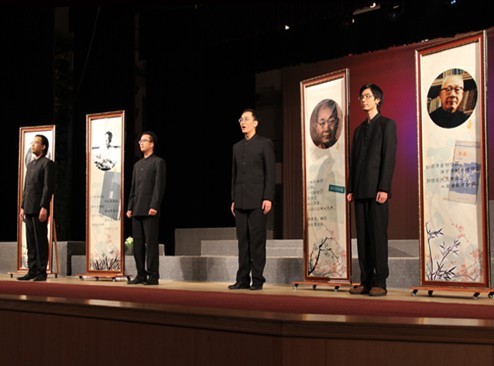
The prelude of the drama
LIANG Zongdai (1903~1983), was a renowned poet, translator, scholar, educator and pharmacist. His expertise lay in Chinese ancient classics, western literature, Chinese poetry and Chinese herbal medicines. He was one of the most popular "new poets" writing in free verse after the "May Fourth Movement" in China. He published two collections of poems, An Evening Prayer, Lu Di Feng, and a collection of essays, Poetry and Authenticity. His translation works included Sonnet by Shakespeare, Doctor Doctor Faust by Goethe, poetry by Tao Qian, Blake, Rilke, and Valery, as well as Essais de Montaigne. Apart from his achievements in literature and translation, he devoted his later years to education in the Guangzhou Institute of Foreign Languages, which later became Guangdong University of Foreign Studies, where he also studied Chinese herbal medicines, and often treated patients for free.
The drama took a glimpse at LIANG's life, from his early days to twilight years. Time has witnessed the changes in his different life spans: the enthusiasm of poetry in his youth, the cavalier spirit to help the weak in his middle age, and his devotion to medicine when he was old.
In his youth, LIANG Zongdai traveled and studied in Europe, becoming good friends with Romain Rolland and Paul Valery. When his country suffered in war, he decided to return to teaching. In the local literature saloon in Beijing, he frequently debated on poetry, and there he met CHEN Ying, the woman writer with whom he later married in Japan.
In the prime of his working life, he was courted as a member of Think Tank by Chiang Kai-shek, but he rejected this, pretending to be drunk. Back in his hometown, he saved an opera singer GAN Shaosu from her abusive husband, and they fell in love.
In the Cultural Revolution, he was condemned to prison with most of his works destroyed. In pain he gave up his pen and indulged himself in studying medicine till his twilight years. He started working again in translation but died before Doctor Faustus was finished.
During the opera, in the dim light, three LIANGs from different periods of his life appeared on the same stage. They broke the limits of time and space and were engaged in the same conversation, which allowed the audience to catch the distinctive differences in the personalities of LIANG from different periods. YE Tao, ZHANG Pengjie and WU Huaxing played the roles of the three LIANGs in youth, middle age and later life respectively.
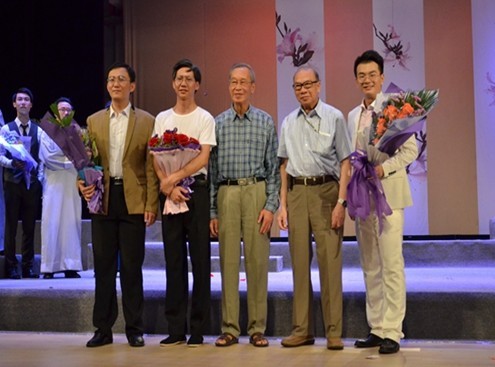
LIANG's two brothers and three actors who played LIANG
The drama has won much positive feedbacks from the audience. LIANG Siwei, the daughter of LIANG Zongdai, extended her compliments on the performance. "The arrangement of the play is highly unique and innovative." she said. She thought that the cast has captured the essence of her father's life in just two hours.
A retrospective view on the life of LIANG Zongdai is as follows.
1903: LIANG Zongdai, whose ancestral home was Xinhui, in Guangdong Province, was born in Baise city of Guangxi province. Brought up in a rather poor family, his father, LIANG Yijue, gave up his opportunity to attend school and started own his business, always rather regretful that he did not receive a formal education.
1917: LIANG Zongdai, at 14 years of age, went to Guangzhou all by himself to attend Pui Ching Middle School, a well-known school in the Dongshan District. During his schooling, his English teacher was greatly impressed by his enthusiasm for Dantes Divine Comedy, as translated by Longfellow
1919: When Liang was 16, the May 4th Movement broke out and, under the influence of the concepts of anti-imperialism and anti-feudalism, he was an active participant in mass marches and rallies. He became editor-in-chief of both the Pui Ching Journal and the Student Weekly. Under his pen-name, "Pugen", many poems were published by Liang, all of which helped him to earn a reputation as a South China Poet, attracting a large number of followers, among them reporters who frequently commented on the meaning of his verses.
1921: Invited by Zheng Zhenduo and Mao Dun, Liang became the fouth person of Cantonese origin who obtained membership in the Literature Seminar, an influential literature association in the May Fourth Movement. At that time, he was still a student of 18 years-of-age. As was customary, Liang's parents decided his marriage to Miss He, who was totally unknown to Liang..
1923: With great honors, Liang was recommended to the Liberal Arts Faculty of Lingnan University. Following his appointment, he organized the establishment of a Literature Seminar/Guangzhou Branch with many coworkers, like Liu Simu and, at the same time he took up the task of writing articles for the pages of the Vietnam-China News to publish the ten-day Periodical of Guangzhou Literature.
1924: An Evening Prayer, Liang's first poetry anthology, was published by the Commercial Press. During this time he also furthered his studies in France, where he had been longing to visit all his life.
1926: During his stay at the School of Literature of the University of Paris, he majored in French Literature. His schoolmates introduced him to the great French symbolist poet, Paul Valery.
1927: Valery explained his interpretations as related to his work, the Songs of Narcissus. Liang then translated that long poem and another one into Chinese. The two were published in the literature review, Novel Weekly. It marked the debut of the masterpiece of a great French poet in China.
Additionally, LIANG published his poems written while in France in renowned magazines such as Europa and European Review. He also translated and published the poems of ancient, great poets like Tao Yuanming and Wang Wei.
1929: Liang met Romain Rolland.
1930: In this year he went to the University of Heidelberg to learn German. Meanwhile,the French version of his Poems of Tao Qian was published in Paris and Valery wrote the preface of the book.
1931: Liang was admitted to the University of Florence in the Autumn of this year to study Italian. During that same autumn, he was invited by Jiang Menglin and Hu Shi to work as a director and a professor in the French Department of Peking University. At the same time, he was also a lecturer at Tsinghua University. He met and became acquainted with Hsu Chih-mo that same year.
In his Middle Age
1931: Liang met a female writer of Chinese New Literature, Chen Ying. They shared many common interests, especially a mutual enthusiasm for literature and, with time, they fell in love.
1934: Liang asked for a divorce with He. Finally Liang lost in the divorce proceedings and left with Chen Ying. He then married Chen and they studied in Japan together. At the same time, his relationship with HU Shi worsened and he resigned from his post in Peking University.
1936: Liang was employed as a professor in the English Department of Nankai University. His translation of the Essays by Montaigne was published in the World Library.
1937: His first daughter with Chen was born at Nankai University and was named Siwei because, in France, he had loved a woman named Bai Wei. In the same year his translation of the poetry anthology All the Peaks was published by the Commercial Press.
1938: At this time he was employed by Fudan University and served as a professor of foreign literature. At that time he was committed to helping students to become well-versed in both Chinese and Western knowledge.
1941: He returned to Baise for family business and met a Cantonese opera artist, Gan Shaosu. Deeply touched by her miserable life experiences and her strong will, Liang developed a crush on her. Then, regardless of being contrary to public ethics and principles, they fell in love.
1944: News of the romantic affair eventually reached Chen's ears. She was so irritated that she left him with their children. In Autumn, Chiang Kai-shek, hunting for Think Tank members promised Liang high positions in order to recruit him. Liang, however, refused. He then returned to Baise and went on with his translation of the Essays. While he began to translate Goethe's Doctor Faust, he was beginning to study herbal medicine.
His Twilight Years
1950: As a special delegate to participate in the People's Congress of Guangxi Province, LIANG was elected to be a member and a Provincial Counselor in the first session of CPPCC Provincial Committee.
1951: Liang's directness and outspoken manner of speaking offended the local bureaucrats and he was sent to prison. The misery of his experience in prison caused his first "death". Rumors of his death disseminated in Hong Kong, Macao and overseas. His friends even organized memorial events for him.
1954: In this year the Local Government announced that Liang was acquitted of all charges.
1955: He went to Guangxi People's Hospital in Nanning for clinical trials related to use of two drugs; he failed, test results proving him a user.
1956: Still, when a French major was to be established at Sun Yat-sen University, Liang was hired as a professor. Then he was employed as a member of the academic committee of Sun Yat-sen University.
1957: He was elected to be a Council in the China Association for Promoting Democracy/Guangdong Branch and a member of the council of the Writers Association as well. He was also elected a member of the second , third and fourth CPPCC.
1966: When the Cultural Revolution broke out, Liang was persecuted. However, during the violence of the political campaigns, he continued to defend for Liu Shaoqi. A large number of documents, photo albums, letters, calligraphy and pictures were ruined at that time. Rumors of his death floated again in Hong Kong.
1968: In this year he was sent to do labor work in a rural area.
1969: Because of the harsh living and working conditions, he suffered from sepsis with acute jaundice. Thanks to treatment received in Guangzhou, he recovered from this serious illness. In September, he was sent to Yingde farm but was soon set free in November. Finally, he was released and was able to recover all his wages and his bank accounts. He was free at last.
1970: He worked as a professor of French at the Guangzhou Institute of Foreign Languages. He participated in the compilation of the New Concise French-Chinese Dictionary. Additionally he retranslated Shakespeares Sonnets and Faust. Liang continued to study Chinese herbal medicine and recorded his experience in My Process of Learning Pharmaceuticals .
After that, Liang Zongdai spent the rest of his life at the Guangzhou Institute of Foreign Languages.
1983: Liang passed away. Then the Ministry of Education, the Guangdong Provincial Government and other institutions, his friends...people such as Hu Qiaomu, Ba Jin, Zhu Guangqian, Liu Haisu, Ouyang Shan, Luo Peiyuan and other celebrities expressed their condolences at his passing.
News&Opinion
 more
more- CSC Held the First Chinese Higher Education Exhi...
- The English craze and the revival of Chinese
- China Week Opens at Mexican University
- Halloween gaining popularity but still sees cult...
- SHNU’s Confucius Institute of Fukuyama Universit...
- China bolsters SCO education cooperation
- London mayor launches city's Chinese-language we...
- Chinese and Arabic national museum directors meet
Policy&Laws
Chinese Language Teaching Conference Kicks off i...
The second "Silk Road" international conference on Chinese langua...
Chongqing to offer 72-hour visa-free option
Chongqing is going to offer 72-hour visa-free stays to visitors from...
More foreigners get residency permits
A larger number of Chinese permanent residency permits were issued i...
 |
 |
 |
 |


Hangzhou Jiaoyu Science and Technology Co.LTD. All Rights Reserved
Enterprise Business License : 330108000013977
License Number for Value-added Telecom Business : B2-20080090
Service Hotline :+86 15857187587 Contact Email: admission@126.com