




A worldwide breakthrough--Digital PET System invented by HUST

 print
print  email
email  Favorite
  Transtlate
 Nowadays, the world’s most advanced medical imaging equipment is the positron emission tomography (PET). Recently, HUST Prof. Xie Qingguo and his research team successfully invented the first digital PET system that could trace tumors one twentieth of the smallest ones traced by commercial PETs. Domestic and foreign experts considered that the new system might make a breakthrough in human’s cancer prevention and early diagnosis.
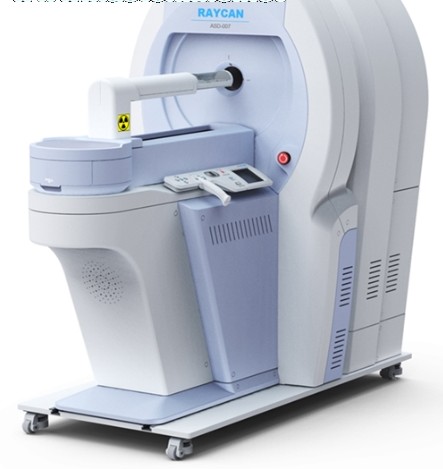
On Dec. 10th, Prof. Xie demonstrated the 1.3×0.8×1.6 cubic meters medical equipment. He introduced that the digital PET had already accomplished some researches in mice and proved its superiority in spatial resolution. Compared with the best spatial resolution 4.1mm of commercial PETs, this digital PET has a 1.5mm spatial resolution, allowing it to detect lesions of 3.4 square millimeters.
Since its birth in the 1970s, PET has been widely used in the global medical field because of its advantage of non-invasive visualization of physiological activities. However, its digitalization has long been a hard target for many countries’ scientific and industrial fields.
Prof. Xie and his research group from13 different majors created the multi-voltage threshold sampling method through 11-year continuous efforts to obtain adequate information and rebuild exact images.
Prof. Zhang Yongxue, chairman of the Nuclear Medicine Branch of Chinese Nuclear Society stated that any improvement in resolution, would be a revolutionary breakthrough in medical science. Additionally, Dr. Gao Jianmin, tenure professor of the University of Chicago, praised Prof. Xie for creating the precedent of the first digital PET.
News&Opinion
 more
more- Chinese Community Christmas charity bazaar raise...
- Geological Museum of Central South University of...
- Ni hao ma?
- Hunger Campaign in World Food Day
- Mo Yan the First Chinese Nationality Nobel Prize...
- Program Promotes Chinese Culture in Uganda
- Mid-Autumn Street Fair held in San Francisco Chi...
- Sepcial Report----Doctor Inspires Others at Quak...

Policy&Laws
Hanban sets guidelines for Mandarin teachers
The revision of The Standards for Teachers of Chinese to Speakers...
Special Skills in Sports and Arts are required i...
In the National Plan and Outline for the Reform and Education of Mid...
Regulation of HIV/AIDS Prevention and Control at...
Regulation of HIV/AIDS Prevention and Control at Frontier Port...
 |
 |
 |
 |


www.study- in- china.org (the earliest institution to enroll foreign students in China) copyright 2003-2012
Hangzhou Jiaoyu Science and Technology Co.LTD. All Rights Reserved
Enterprise Business License : 330108000013977
License Number for Value-added Telecom Business : B2-20080090
Service Hotline :+86 15857187587 Contact Email: admission@126.com

Hangzhou Jiaoyu Science and Technology Co.LTD. All Rights Reserved
Enterprise Business License : 330108000013977
License Number for Value-added Telecom Business : B2-20080090
Service Hotline :+86 15857187587 Contact Email: admission@126.com