




Professor Antti Niemi Visited Shanghai University

 print
print  email
email  Favorite
  Transtlate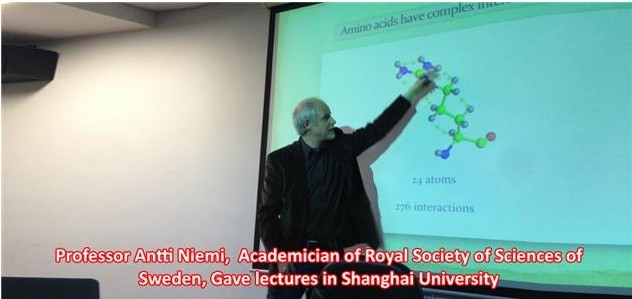
Prof. Antti Niemi, the Academician of Royal Society of Sciences of Sweden, visited the College of Sciences and gave a presentation on “Strings and Solitons: How proteins find their ways to self-organize” in Room F307 at 2:30 pm on March 13, 2013. The colloquium was hosted by Prof. Ying Jiang, the Eastern Scholar and the deputy director of the Institute for Theoretical Physics at Shanghai University.
Professor Antti Niemi is an internationally renowned theoretical physicist, he is also the academician of Royal Society of Sciences of Sweden and the academician of the Finnish Society of Sciences and Letters. He creatively developed Chen Ning Yang-Mills (YM) theory, which has caused a new trend of research in this area. He did many pioneering work in the field theory, particle physics, condensed matter theory, nonlinear physics, theoretical biophysics, and many other areas in mathematical physics. He obtained the U.S. Department of Energy Outstanding Young Scientist Award in 1986, and was awarded the Goran Gustafsson Prize by the Royal Society of Sciences of Sweden in 1994.
In this talk, Professor Antti Niemi introduced their latest work on protein folding. The way and how proteins fold into their biologically active conformation, is among the most important conundrums in science. The functionality of a protein depends entirely on the three-dimensional configuration which it assumes upon folding. Wrong fold is a cause for protein to lose its function. Wrongly folded protein can even be fatal and dangerous to a biological organism. For example, it is now widely accepted that many degenerative diseases various forms of cancer are caused by wrong folding in certain proteins. All this makes it very important to learn how to describe the three-dimensional shape of proteins.
In this talk, Prof. Antti Niemi argued that the modular building blocks of biologically active proteins can be interpreted in terms of solitons, the paradigm structural self-organizers in Nature that describe a wide range of phenomena in physical, chemical and biological scenarios. He first gave an overview of the biophysical structure of proteins, and then explained that solitons are the correct framework for describing their dynamics and geometry. The numerical simulation shows that their simple theoretical model can describe the folded protein in extremely accurate way.
The talk has lasted for about one hour. During the colloquium, the students and researchers had extensive interaction with Prof. Antti Niemi, this talk also provided a good opportunity for all of us to learn the latest progress in research work on protein folding.
News&Opinion
 more
more- English-medium Master''s Program of Electronic a...
- Anna Pao Sohmen believes life is education
- Big Advantages for Foreign Students and Workers
- Little Confucius Talk with Foreign Confucius
- Recruitment of Foreign Students Studying in Chin...
- More people interested in Chinese Language
- Universities: Leaders or Followers?
- Chinese Community Christmas charity bazaar raise...

Policy&Laws
Regulations for International Students Applying ...
The China Academy of Art, formerly the National Academy of Arts,...
National program to keep TCM healthy
China's top traditional Chinese medicine authority has announced a n...
Confucius Institute Scholarship 2013 of Xiamen U...
In order to support the development of Confucius Institutes, faci...
 |
 |
 |
 |


www.study- in- china.org (the earliest institution to enroll foreign students in China) copyright 2003-2012
Hangzhou Jiaoyu Science and Technology Co.LTD. All Rights Reserved
Enterprise Business License : 330108000013977
License Number for Value-added Telecom Business : B2-20080090
Service Hotline :+86 15857187587 Contact Email: admission@126.com

Hangzhou Jiaoyu Science and Technology Co.LTD. All Rights Reserved
Enterprise Business License : 330108000013977
License Number for Value-added Telecom Business : B2-20080090
Service Hotline :+86 15857187587 Contact Email: admission@126.com